
There Are Three Americas. And It's Always Obvious Which One You're In.
After living outside the U.S. for nine years, I see something new in my home country.

For the audio version of this article, read by the author, go here.
Michael and I are back in the United States for a bit, and he recently wrote about how he and I visited Seabrook, a “planned” vacation town on the coast here in Washington State.
He liked it, but I didn’t, and it took me a while to figure out what I found so off-putting about it.
After all, it’s an objectively charming place: a collection of quaint seaside houses and a picturesque little downtown, all built according to the principles of “new urbanism,” where everything is supposed to encourage interaction with your neighbors and build community.
This is all stuff I heartily support.
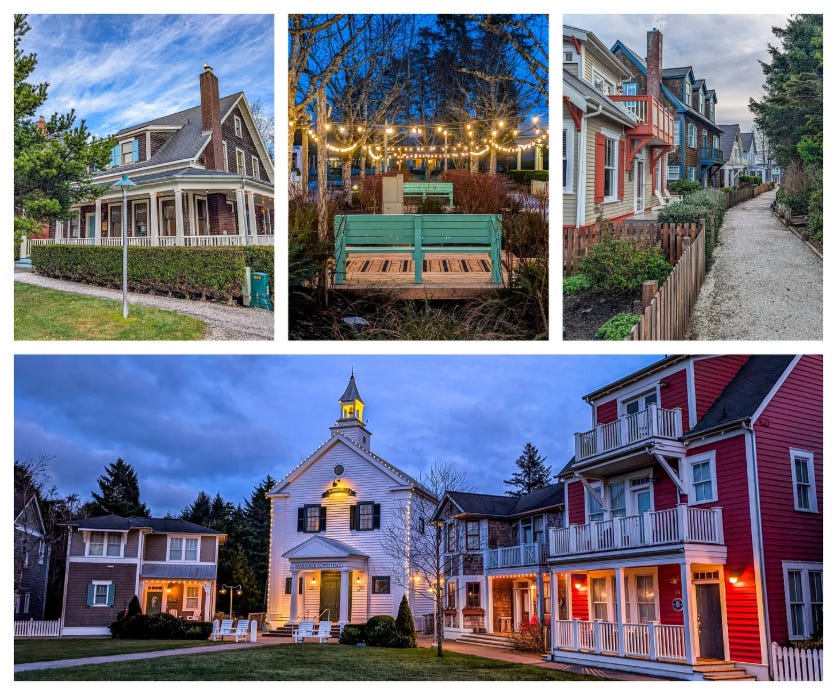
But when I looked up the rent on a small house or cottage at Seabrook for this summer, I was shocked to see that everything started at $5,000 USD a week — more than $700 a night. For a larger place, it’s twice that (or more).
I realized what was bothering me: Seabrook is essentially only available to the rich.
Being back in the United States after nine years away, I’m discovering that America is increasingly being divided up according to wealth.
Basically, there are three Americas: one for the rich, one for the middle class, and one for the poor. And no matter where you are in this country, you almost always immediately know which “America” you’re in — whether it be a neighborhood, mall, restaurant, or supermarket.
If you shop at gourmet shops and high-end specialty markets (or have someone do it for you), you’re rich. If you love Costco or Trader Joe’s, you’re middle-class. And if you’re a patron of Walmart or the food bank, you’re probably poor.
America is, of course, an extremely wealthy country. Despite having a little over four percent of the planet’s population, it controls more than 30 percent of the world’s wealth.
But the wealth here is distributed in a wildly unequal way.
There’s a small group of really rich folks, with the top one percent controlling more than 30 percent of the country’s overall wealth, and the top ten percent controlling more than 70 percent. And these rich people are getting richer really fast.
There’s also a sizable but shrinking middle class.
And there’s a growing underclass that is seriously struggling. America’s bottom fifty percent only control two to three percent of the country’s total wealth.
Everyone in every class is richer than they used to be, even when adjusting for inflation. But the wealthier are much richer now.

To some degree, America has obviously always been divided by wealth. But the scale has changed. And these days, the businesses of America are increasingly catering primarily to wealthy folks.
Whether it’s airline seats, cars, fashion, or home design, “affordable” is out and “luxury” is in.
And why not? The rich are the ones with all the money to spend, so this is now where the profits are. In our “K-shaped” economy, this is becoming even more true as the poor and middle class cut back and the rich continue to spend.
This might all be less obvious to foreigners who have only visited the United States once or twice, or to Americans who have lived in this country their entire lives.
But as someone who lived most of my life in the United States, left for nine years, and has now returned, the change is stark and incredibly obvious. It’s literally all around you now, everywhere you turn.
If you’re rich and taking one of your many annual flights, you wait in one of the country’s increasingly opulent private airport lounges, and on the plane, you sit in one of the ever-more-lavish first-class cabins. If you’re middle-class, you sit in business or economy. And if you’re poor, you’re rarely on the plane at all.
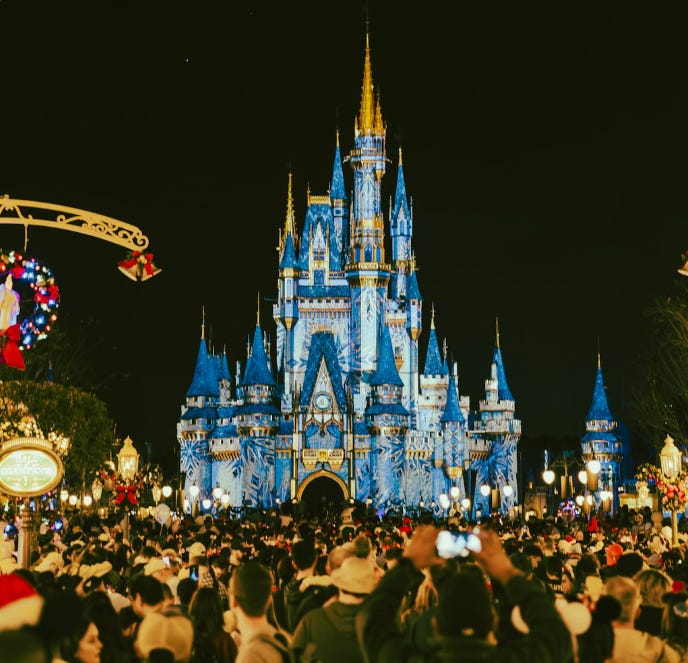
If you’re rich and visiting one of the Disney parks, they let you in early, plus you get to skip the insane lines entirely. If you’re middle-class, you mostly endure the hordes. And if you’re poor, you don’t go at all.
If you’re rich, you don’t hesitate to shell out $1,500 on concert tickets to your favorite artist, or $500 for a good seat at a hit Broadway show, or $50,000 for a VIP suite at your local sports stadium, which was probably recently rebuilt specifically to include more such seating. And if you’re middle class…
Well, you get the idea.
In many of these cases, the experience is technically still available to the middle class (if not to the poor). But you’ll have to pay through the nose to get it — or you’ll have to endure the increasingly miserable non-“premium” version.
Almost every country has its rich, of course, and openly catering to the wealthy is definitely a worldwide phenomenon.
It’s also worth noting that even middle-class Americans like myself are essentially “rich” when we travel outside the United States: almost every other country in the world is much more affordable.
But America still seems more segregated by wealth than most places — in part because there are simply more rich folks here. Also, America celebrates “excess” in a way that most places don’t.
I once had an American say to me, completely without irony, “I’m not materialistic — I just like nice things.”
And cities play a different function in America than elsewhere: less about all classes of society mixing together and more about being playgrounds for the ultra-rich and holding pens for the desperately poor.
Meanwhile, in most of the sixty-four other countries I’ve visited, people seem more content — because their governments provide better social support, the families are tighter, or both.
In Switzerland, for example, prices are even higher than in the United States, but the wealth is much more evenly distributed, and there’s a strong government safety net. And Mexicans know they can’t rely on their government for much, so they have cultivated incredibly strong familial relationships and social networks.

To be fair, the rich in America do pay a premium for their luxury lifestyles.
Michael and I are middle-class, so we’ll be spending our summer not at Seabrook but in a condo in a different town on a different Washington beach. We’ll have access to a gym and hot tub (and an arguably better beach), plus weekly housekeeping, but it’s only costing us $2,700 a month — not the $20,000 that a similarly sized unit at Seabrook would cost.
Our condo is a bit dated, and the town is kind of ragged — Seabrook is definitely more charming.
But Seabrook is not seven times more charming.
To me, the insane prices that the wealthy pay don’t seem nearly worth it.
On the other hand, I’m not worth ten million dollars. If I were, I probably wouldn’t even notice prices.
The thing about all this is that America really didn’t used to be this way — at least not since the Gilded Age. Almost every American knows or senses that health care and housing costs have recently risen far faster than inflation.
But so has the cost of Disney parks, and Broadway shows, and concerts, and sports events, and restaurants, the prices at most of which have risen at least double the rate of inflation — and much more than that for the premium spots.
Michael and I used to be much less wealthy than we are now, and Seabrook was always a bit pricy, but we could still afford it every once in a while. Not now.
These crazy price increases have come about precisely because the rich in America have become so much richer, and they’re willing to pay these prices — especially as the experiences themselves become ever-more-decadent and exclusive.
Incidentally, if some Americans are now so rich that they can afford $1,500 concert tickets and airport lounges that serve lobster and offer massages, it seems to me that they can also afford to have their taxes raised — not dramatically lowered, as Trump and the Republicans have done. But maybe that’s just me.
Also, I’m frankly tired of Americans giving themselves so much damn credit for being so wealthy. When you travel a lot, you quickly realize that wealth is, yeah, partly about talent and hard work, but it’s mostly just a function of where you happened to have been born.
Anyway, if the American rich have it so great, the cost of living in the United States is also survivable for those of us in the middle class, like Michael and me. At least we have Costco and Trader Joe’s, even if we now also have an unsubsidized $26,000 health insurance premium, again thanks to Trump and the Republicans.
In other words, in Rich America, life is fantastic. In Middle Class America, it’s at least manageable.
But what about the “third” America: Poor America? How is the bottom forty percent supposed to survive all this? They face all the challenges the poor do in any country, but they also live in a place with weak communities and inadequate government support.
Then again, that’s why most of us go out of our way to avoid Poor America, isn’t it?
Brent Hartinger is a screenwriter and author. Check out my new newsletter about my books and movies at www.BrentHartinger.com. And order my latest book, below.

Occupy Wall Street seems like it happened 100 years ago. Why couldn't Americans have sustained that outrage? Was it just s very vocal minority? Instead, we turn around and elect a greedy, narcissistic, criminalistic, 2nd-generation Wall Street billionaire and his Republican puppets. Talk about Gore Vidal's "United States of Amnesia." I'll never understand why the middle and lower classes support leaders who work against their interests. The GOP is a master of the giant con.
I am a Costco and Trader Joe’s type of guy, and I agree with everything you just said. The cost of living in the US is insane. Normally I am not a fan of taxes, but we are at historically low tax rates and also have a national debt of $39 Trillion and growing. Our national debt is unsustainable. At the same time, costs for everything else are off the charts, and what used to be attainable is becoming priced farther and farther out of reach. If you are a Costco type of family, of a certain age, and have saved and invested well, you’re probably doing ok. But if you are young, of a modest income, or are going through a difficult financial time (medical expenses, job layoff, providing care for a loved one, etc), you’re struggling and it is difficult to keep your head above water much less save and invest.