
That Time Our Plane Caught Fire Over the Atlantic
Ever wonder why airlines are suddenly so worried about lithium batteries on the plane? Michael and I know.

For the audio version of this article, read by the author, go here.
When you’re in a plane thirty thousand feet over an ocean, the one thing you really don’t want to smell is smoke.
It was June 2019, and Michael and I were on our way to Switzerland, our next digital nomad destination.
But thirty minutes into our flight from New York to London, with nothing but the Atlantic Ocean stretching out under us as far as the eye could see, I definitely smelled smoke.
“Huh,” Michael said casually. “The flight attendants must’ve burned dinner.”
I had a slightly different take. I was thinking, Smoke? In the plane? This is it, we’re both going to DIE!
Yes, nomading for two years had made me much more used to unexpected things happening, much better at going with the flow.
But this did not include things like smoke in the cabin of an airplane thirty thousand feet over the Atlantic.
The smoke kept getting thicker, the smell becoming more obvious — more noxious. Not like burned chicken parmigiana. More like charred electronics and melted plastic.
Like the inside of a plane on fire.
Earlier that day, related to nothing at all, I had posted a quote from The Lord of the Rings, something Bilbo says: “It’s a dangerous business, Frodo, going out your door.”
And Michael had commented: “That’s an ominous thing to post right before getting on a flight!”
Three hours later, with our plane rapidly filling with smoke, I was in no mood for irony.
Suddenly, the flight attendants rushed down the aisle wearing oxygen masks and clutching fire extinguishers. I didn’t see any actual flames. Then again, the flight attendants were running toward the First Class section — obviously very far from our seats.

But by now, I could very clearly see a haze in the air.
I glared at Michael. Did he still think the flight attendants had just burned dinner?
A moment later, the captain spoke curtly over the PA system: “Ladies and gentlemen, we’re diverting to Boston for an emergency landing. We’ll be on the ground in thirty minutes. Please do not get out of your seats.”
An emergency landing? Shit was getting real fast.
Really? I thought. For once, I was right to jump to the worst possible conclusion? I wasn’t sure whether to be freaked out or proud of myself.
“Everything’s going to be fine,” Michael said. “Whatever’s going on, I’m sure they have things completely under control.”
“Oh, yeah, I’m not worried, not at all,” I said, because I always lie to Michael about how anxious I am in any given situation.
We still couldn’t see what was happening up in the First Class section, which was obscured by a curtain.
Around us, the other passengers were oddly subdued. Or maybe they were just stunned.
I tried to listen in on the conversations around us, but I couldn’t hear a damn thing. Had the roar inside the plane always been this loud? It had to do with the speed of the plane, right? Because we were screeching through the sky in a fragile metal tube at God-knows-how-many miles per hour?
“Seriously,” Michael told me. “I’m sure everything’s fine.”
“What do you think it is?” I asked, because years ago he had worked as a flight attendant.
“I honestly have no idea.”
I glared at him again. He’d worked as a flight attendant. How could he not have any idea what was going on?
“Is it the engines?”
“No,” he said. “We couldn’t smell that in here. It’s probably just the wiring or something.”
“’Just the wiring? What are they doing about it?”
“Well, you saw the fire extinguishers. They use a special kind, halon extinguishers. They’re amazingly effective. Don’t worry. It’s not like the whole plane is going to catch on fire. Everything is built exactly for problems like this.”
Problems like WHAT? I wanted to say, but I knew Michael didn’t have the answer. That’s part of what was so scary about this — not knowing how serious it was.
“But,” he went on, “you should probably put your shoes on in case we have to evacuate.”
Evacuate?! I thought there was nothing to be worried about! My husband seriously needed to get his story straight.
The minutes ticked by, and I sank down in my seat.

The plane’s nose dropped, and I thought, Here we go, the end has come at last!
The fire had probably burned the wiring completely away, and the pilots had finally lost control of the plane. Or maybe it had spread out to the wings, and the engines were now engulfed in flames.
I wondered what it would feel like when the plane made impact against the water. Would I feel anything? With any luck, we’d all die instantly.
But, unexpectedly, the plane stabilized, and we kept flying forward. The pilots still had control. When I looked out the window, the wings weren’t on fire.
I spotted land, the Eastern Seaboard. But I could still smell that damn smoke in the cabin. Plus, I wasn’t sure if planes that crash on land have any greater a survival rate than those that do it at sea. Maybe you were better off crashing into water. Those slides detach and become rafts for a reason, right?
Then my ears popped, and I realized we were starting our actual descent into Boston. It all felt weirdly normal. They even told us to turn off our electronic devices for the landing.
But I could still smell smoke — pretty damn strong too. And if the wiring really had caught fire, did the pilots even have control over the landing gear?
I held my breath the whole way down, or at least it felt like I did.
Almost exactly thirty minutes after that announcement from the captain, we finally touched down in Boston. When we stopped, a dozen fire trucks instantly surrounded us, their red lights spinning ominously in the dark.
I thought: What would’ve happened if we’d been six hours from land?
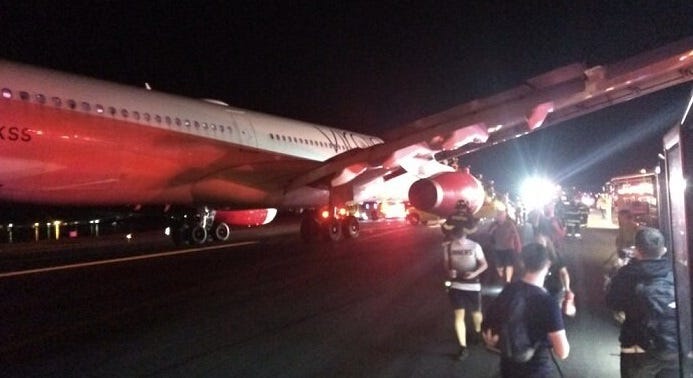
One woman had a panic attack and was immediately taken off the plane. Everyone else was told to stay put.
The captain, intense but in control, came back to talk to the passengers personally, to make sure everyone else was okay.
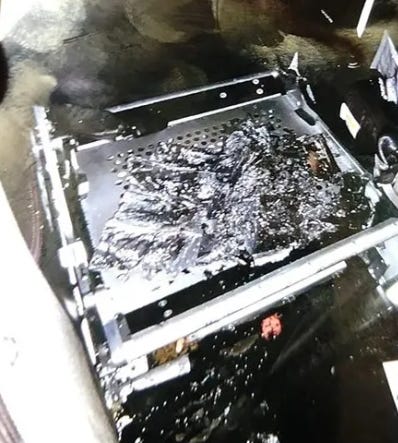
He admitted the situation had been just as serious as it seemed. A passenger’s lithium battery pack had overheated. It had slipped down between two First Class seats, eventually setting one on fire.
When we were finally allowed to leave, we saw for ourselves that the seat had been reduced to its metal frame, charred and twisted.
The incident ended up making the national news.
And if you’ve ever wondered why airlines now seem so worried about passengers bringing lithium batteries onto the plane, this is why.
In fact, even halon extinguishers don’t work well on lithium batteries. These days, airplanes now carry special bags they can use to seal and smother an overheating lithium battery.
Ironically, this wasn’t even our first encounter with fire on our travels. The year before in Bulgaria, our apartment caught on fire.
Once we were in the airport, I said to Michael, “What is it about us and fire?”
Michael laughed. “I know.”
“Seriously, did we make a mistake with this whole digital nomad thing?”
“Something bad could have happened even back in Seattle,” Michael said. Which was true.
But it’s also true that it is a dangerous business going outside your door, just like Bilbo says.
Ironically, we feel safer outside of the United States than we ever did back home, because of the prevalence of guns in America and how much more time Americans spend in cars.
And, er, fascism.
But we’re also in lots of unpredictable places and situations now, so bad things can and do happen.
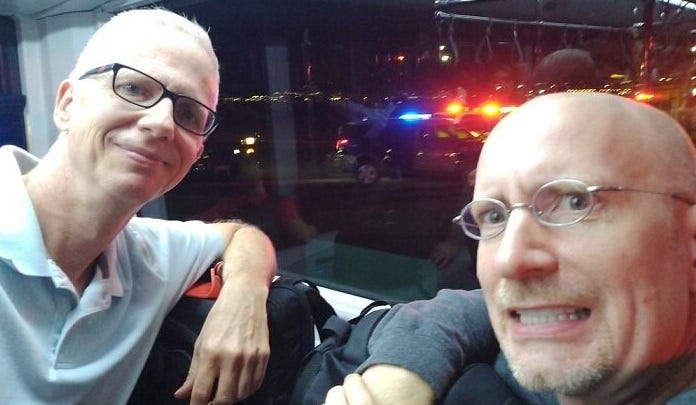
But life is also more interesting than before.
In The Lord of the Rings, when Bilbo warns Frodo, he’s talking about orcs and goblins, which we’ve managed to avoid — so far.
But Bilbo is also talking about how adventures force you to confront uncomfortable realities about the world around you, and also about yourself.
Leaving home forces you to change.
Obviously, travel isn’t the only way people can open themselves up to new possibilities. But since becoming a nomad, I’ve been pushed to do things I’d never done before — to live far outside my comfort zone.
But I’ve also discovered that, weirdly, it isn’t nearly as scary outside that zone as I thought.
I don’t want to die. But I also know that if I’m ever on a plane that really does crash, in the moments before the end, I’ll have many fewer regrets now than I would’ve had before.
In other words, I’m really glad I stepped foot outside my door.
Brent Hartinger is a screenwriter and author. Check out my new newsletter about my books and movies at www.BrentHartinger.com. And order my latest book, below.

I’d rather be in a burning plane over the Atlantic than around the MAGA Cult and ICE murderers back in the U.S.
I can't stop laughing about you debating whether to be freaked out or proud of yourself for going to the worst case scenario. We are days away from boarding a plane for a two month house/petsit in Hawaii in the middle of the winter. Thanks go to you two again for introducing us to TrustedHousesitters. The risk is definitely worth the adventure!