

For the audio version of this article, read by the author, go here.
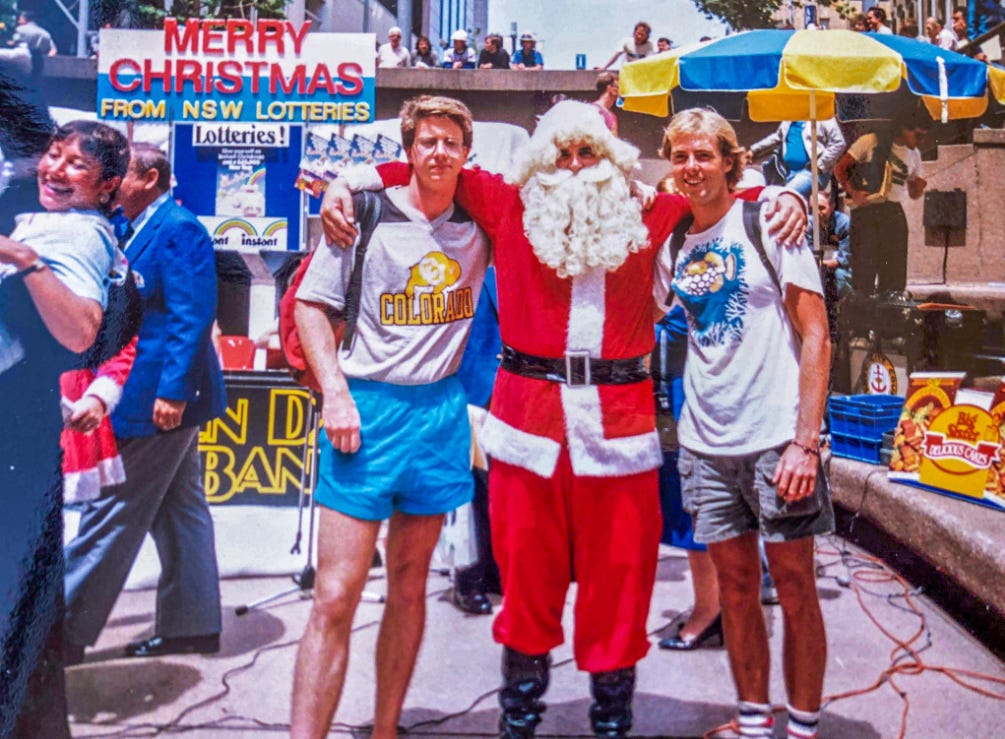
It was January 1988, and my college buddy John and I, both in our early 20s, were backpacking around Australia until mid-April, when my new job started as a tour guide at the World Expo in Brisbane.
At the moment, we stood hitchhiking on the side of the road in rural New South Wales, somewhere between Sydney and Melbourne, desperately waiting for a driver to give us a lift.
But on this lonely stretch of road, potential rides were few and far between. And none of the handful of cars we’d seen had stopped.
We weren’t surprised. We’d already learned that some drivers didn’t want to pick up two men. Sometimes, when the wait got too long, we’d split up and then meet up again later in the next town.
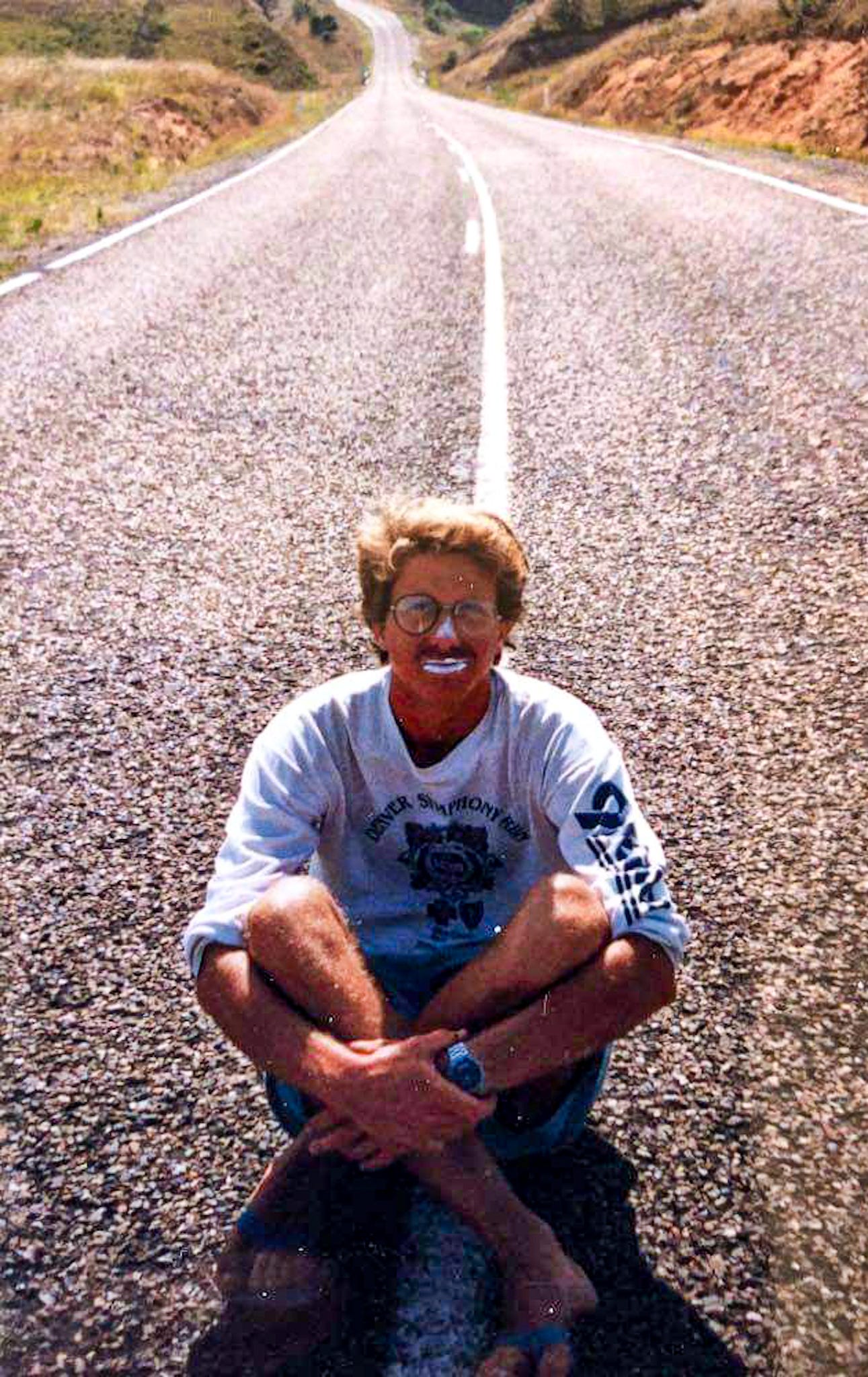
But with so few cars passing by, splitting up didn’t seem like a great idea. So we waited together, the summer sun beating down on us, the heat radiating off the sticky black tarmac.
In fact, this was the day John snapped one of the few pictures I still have of our trip together.
Finally, a car stopped. I’m not a car guy, but I do remember it was an older four-door car of some kind.
The driver was a white man, as nondescript to me as his car. He had dark hair and was somewhere in his thirties or early forties.
He nodded us in without asking where we were headed. Then again, it didn’t much matter to us, as long as it got us farther down this lonely road. John hopped in the back while I climbed in the front.
The man started driving, staring straight ahead, silent and intense. The radio was off as the road ticked by beneath us.
This felt strange. Every other driver had been friendly, asking us questions like, “Where are you from, mate?” Or, “American, eh? What do you think of Australia?”
An uneasy feeling dropped into the pit of my stomach, a seed taking root.
Now I stared straight ahead too, looking at his cluttered dashboard. It reminded me of a junk drawer, covered with stickers and littered with knick-knacks — some religious in nature. There was a statue of the Virgin Mary glued to the dashboard and a cross dangling from the rearview mirror.
And there was also a VHS copy of The Hitcher, the 1986 movie about a man who picks up hitchhikers and, uh, murders them.
Seriously.
I glanced back at John, but he was in the backseat, staring out the window. If he’d noticed anything off, he gave no sign of it.
That feeling in my stomach grew, uneasiness snaking outward. If fear were a plant, its tendrils would’ve been spreading out into my chest, my arms, and my head.
The car rumbled down that empty stretch of road, the driver still staring straight ahead as if we weren’t there.
My eyes scanned ahead, too, looking for oncoming traffic. Seeing another car wouldn’t necessarily change whatever was happening here, but at least I wouldn’t feel as isolated as I did right then.
But there were no other cars and now, the fear blooming into full-grown panic, my gut shouting: This feels bad. Very, very bad!
So when we came to the first stop sign less than ten minutes later, I immediately said, “This is great! Come on, John! Let’s go!”
Before the driver could react, I opened my door and leapt out. I also opened John’s door, urgently motioning him out, while I grabbed my backpack.
The car sat there a moment, the engine idling, while I willed the driver to pull away. Finally, he did.
John, who hadn’t seen what I had, didn’t understand what was going on.
But the encounter stayed with me. And when twenty years later, I learned about a man named Ivan Milat — the so-called “Backpacker Killer” — who had been convicted of murdering seven young hitchhikers in the late 80s and early 90s, my mind flashed back to that day.
All were backpackers in their late teens or early twenties. All had been hitchhiking between Sydney and Melbourne. And all of them disappeared in New South Wales, the area where John and I had also been hitchhiking.
Milat’s first confirmed victims, James Gibson and Deborah Everist, both 19, vanished in December 1989. In the years that followed, five more backpackers disappeared under similar circumstances — all of them picked up along the Hume Highway between Sydney and Melbourne.
He might never have been caught if not for a British hitchhiker named Paul Onions. In early 1990, Milat picked him up along the highway. At first, everything seemed normal. Then Milat pulled out a gun.
Onions managed to escape and reported the incident to the police. At the time, nothing came of it.
But years later, after the bodies of the missing hitchhikers were discovered in nearby Belanglo State Forest, Onions saw the news and contacted authorities again. His testimony helped lead to Milat’s arrest and conviction. (After the trial, police were roundly criticized for not having done more and possibly prevented at least some of the other murders.)
Keep in mind that travel was very different forty years ago. There was no internet, no smartphones — not even cell phones.
Using payphones, I called my parents back in America once a month, if that. If I’d disappeared, they would’ve had little idea where I’d been. Often, I only had the vaguest idea where I was going. There’s a lot of space between Sydney and Melbourne.
Travelers like me made it easy for this serial killer to get away with his crimes.
Is it really possible that the man who picked us up was Ivan Milat?
There are reasons to think it wasn’t.
For starters, we hadn’t been picked up on the Hume Highway, but on a more rural road in the same area. Also, when Milat picked up Onions, he’d driven a truck, not a four-door car. And our driver had seemed anything but “normal” right from the start.
But the main reason it might not have been him is that Milat didn’t murder his first victims until 1989, almost two years after John’s and my encounter.
That’s a pretty big gap to explain away.
And the truth is, there were a lot of hitchhikers between Sydney and Melbourne in the 1980s. And most of us had stories of the occasional “strange driver.”
But there are also reasons to think it could’ve been Milat.
John and I were backpackers in our early twenties, hitchhiking from Sydney to Melbourne — exactly the kind of victims he targeted in the exact area where he hunted them. And four of his victims were abducted as duos.
I’ve seen photos of him, and it’s been too many years for me to say with any certainty that Milat was our driver, but his age and general appearance are the same. And I’ve since learned he was Catholic, which might explain the religious iconography.
Yes, Onions said he seemed “normal” at first. Then again, maybe Milat moderated his behavior after people like me got spooked by his earlier demeanor — no copies of The Hitcher on the dashboard, for one thing.
And while Milat later drove a truck, he had previously driven, yes, a four-door Ford Fairmont.
But here’s the kicker: police are now almost certain Milat had killed before he murdered Gibson and Everist.
After Milat’s conviction, police began investigating cold cases in that part of Australia, including the murder of 18-year-old hitchhiker Peter Letcher. Police now believe that Milat murdered Letcher in November 1987, just months before John’s and my encounter.
Just like that, the two year gap vanished, putting our encounter squarely within the dates of Milat’s confirmed killing spree.
And while all the other known victims were picked up on the main Hume Highway, Letcher was picked up on a rural road — just like where we had been.
I’ll never know for sure whether I rode next to a serial killer on a lonely road in rural Australia.
The logical part of me says I probably bolted from a strange, religious, but ultimately harmless man with an interest in slasher films.
But the reptilian part of my brain?
It’s really, really glad I got out of that car so fast.
Michael Jensen is a novelist and editor. For a newsletter with more of my photos, visit me at www.MichaelJensen.com.
The gift of fear...
Thank goodness you were paying attention.
Gavin de Becker, author of The Gift of Fear, reminds us why we should always listen to our gut when it's talking to us like that ... when our primitive self is trying to protect us.
A friend worked with a serial killer. Every single day. His strangeness was evident. But nobody knew what he did until years later. I shiver.