
Bread is Better in Europe — and Better For You Too
It's definitely not your imagination.

The best bread I’ve ever eaten was on a road trip with friends through the Eastern European country of Armenia.
This particular bread, called lavash, is a staple in this area of the world. It’s technically a flatbread, but many varieties are leavened.
Our trip through Armenia was back in 2019, before Michael discovered his love of photography and started taking photographs of every frickin’ thing we see, so these are the only pictures I have of The Best Bread I’ve Ever Eaten — but it will also give you a glimpse of some of the other glorious food we had on our Armenian trip:
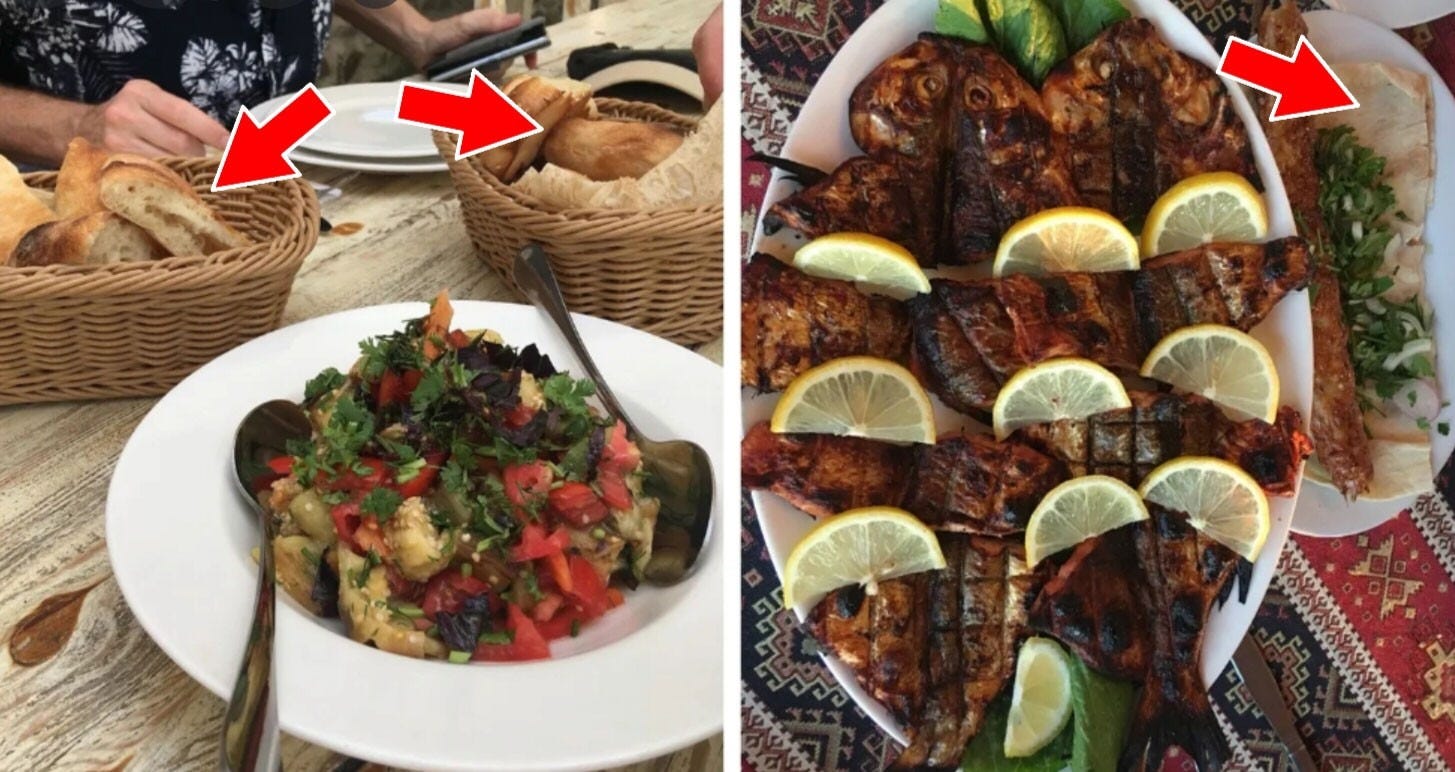
My reaction to this bread wasn’t: Hmm, this is good bread — maybe the best I’ve ever eaten.
It was: This insanely delicious concoction made with wheat is unlike any “bread” I’ve eaten before, and I now realize what a hollow mockery of foodstuffs these baked goods that I’ve been consuming all my life really are!
Look, I’m sure that the fact that this particular style of bread was a novelty to me had something to do with my enjoyment of it — and I was also traveling with wonderful friends through a fascinating new country and culture.

But I would still stake my life that this bread was objectively far more delicious than any bread I’d eaten up until that point.
Over the next few years, as Michael and I traveled all around Europe, the same thing kept happening.
I had gloriously chewy baguettes in France, wonderfully airy pitas in Greece, deliciously dark breads in Germany, hearty whole wheat breads in Norway, gloriously rich focaccias in Italy, deeply delectable rye breads in Switzerland, and on and on.
I also kept personally witnessing anecdotal evidence that food in general was healthier outside of America — like our nomad friend, who had long struggled with his weight, left America and quickly lost fifty pounds, returned to America for a summer and gained much of the weight back, and then left and lost the weight all over again.
When it comes specifically to bread, even my friends who struggle with gluten have fewer problems in Europe. And all my friends and I see fewer other ill-health effects from bread: less bloating, nausea, and even “brain fog.”
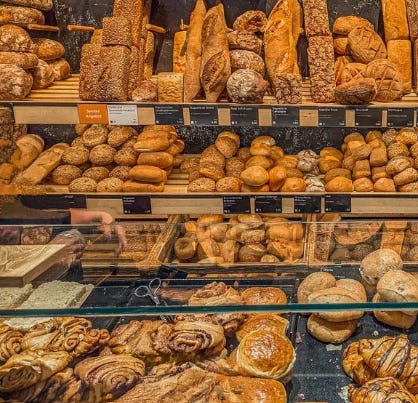
Yes, I know it causes a big argument every time someone says food in America isn’t as good as somewhere else.
And to be clear, you can get truly great bread in America, at certain very high-end bakeries. But it will be really expensive (and it probably still won’t be quite as good).
Plus, virtually no one eats these “specialty” breads on a daily basis, the way ordinary people do all over Europe.
Here are all the reasons why bread is better in Europe:
It’s made fresh every day, all day long — with no additives.
Americans love to innovate, and no one should be surprised that the country has completely rethought “bread,” making it cheaper and able to stay “fresh” much longer.
We were so proud of our innovation of “pre-slicing” bread that we even came up with an expression: “This is the best thing since sliced bread!”
But pre-slicing bread dries it out, and all these other innovations have consequences too. So Americans started adding chemicals to make the bread softer, and preservatives to keep it soft.
All these additives affect flavor. Regular readers also know that I am now a full-fledged nutjob, convinced that the chemicals in America’s food are literally slowly poisoning our residents.
By contrast, European countries mostly continue to use much more traditional bread-making practices.
In Istanbul, for example, you can barely walk a block without seeing a vendor selling Turkey’s iconic street food, the simit: a ring of bread that’s a cross between a bagel and a pretzel.
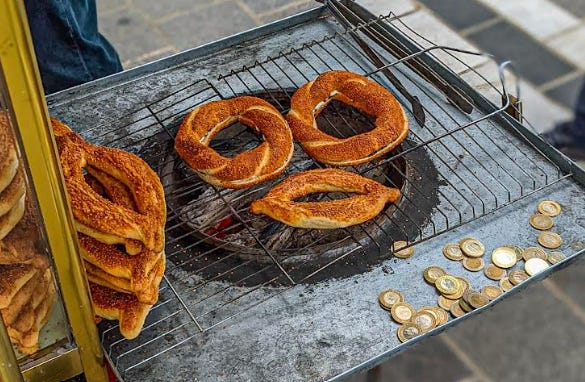
It’s a recipe that has been perfected since at least the 16th century: the dough expertly kneaded and allowed to rise, dipped in pekmez (or grape molasses) and covered with sesame seeds, then blasted with very high heat.
The result is a delightfully crispy concoction with the perfect balance between chewiness and softness, and a nutty flavor — and while it can be served with spreads or toppings, it’s so delicious it usually isn’t. But a cup of çay, or Turkish tea, is strongly recommended.
And can we talk about freshness? When you buy simits from a street vendor, you’re almost certainly eating something that was freshly cooked in one of the many local simitçi, or simit bakeries. These bakeries are everywhere — there’s probably one so close to the vendor’s cart that you can smell it.

As for unsliced bread, in Norway — as in many European countries — all bakeries slice your bread at the time of sale for immediate consumption, and grocery stores even have self-slicing machines so you can cut it yourself.
The wheat and flour are different.
Another one of America’s innovations is “all-purpose” flour, which is just what it sounds like: a single, mid-gluten flour that can be used for almost anything.
This flour is mostly “hard red” wheat, which comes from a hardier plant that can grow in the winter months and contains more gluten. Alas, the resulting flour might also include additives such as nitrosyl chloride, chlorine dioxide, azodicarbonamide, benzoyl peroxide, and glyphosate — a pesticide that is a known carcinogen.
Meanwhile, European countries tend toward softer wheats that come from a more delicate plant, and are also sweeter with no bitter aftertaste — and any additives are much more tightly regulated.
And in Europe, flour is categorized by its refinement — which isn’t about coarseness or color, but rather the amount of “endosperm,” or starchy carbohydrates, in the flour. The flours are then further classified by the amount of protein (or gluten) they contain.
European bakers choose very specific flours for whatever bread or foodstuff they want to cook. American bakers do this too, but not to the degree of Europeans — nor do they have as many options.
When Michael and I lived in Matera, Italy, in 2018, we went to our favorite pizzeria at least once a week, and that’s when I had The Best Pizza I’ve Ever Eaten. The crust had a delightfully thin, soft center, with a puffy, fantastically airy rim — of course, with the trademark char spots from the wood-fired oven.
This would have been made with Tipo 00 flour, which is Italy’s most refined flour.
I don’t have a picture of the Best Pizza I’ve Ever Eaten — because Michael hadn’t started taking photos of every frickin’ thing we see here yet either.
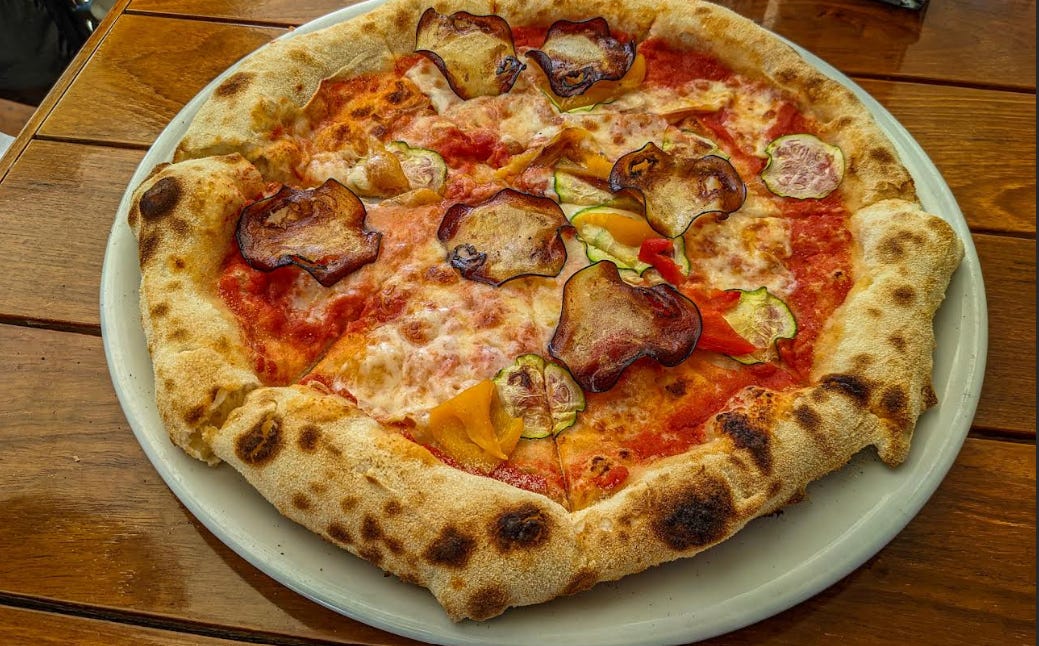
But here’s a random pizza napoletana we had in nearby Naples, which is, of course, (probably) the birthplace of pizza itself:
Annnd finally, the baking process is also different.
Bread with yeast typically takes a fairly long time to “rise” — that is, the yeast ferments sugars in the dough, which produces carbon dioxide that creates air bubbles.
But impatient — and innovative! — Americans have also pioneered all kinds of ways to make dough rise faster: more sugar and yeast, higher temperatures, and more aggressive mixing.
Unfortunately, these tricks can upend the actual fermentation process, which is an actual breaking down of the starches (and reducing the amount of gluten) — things that make digestion much easier. This is why European breads hit the gut so much better.
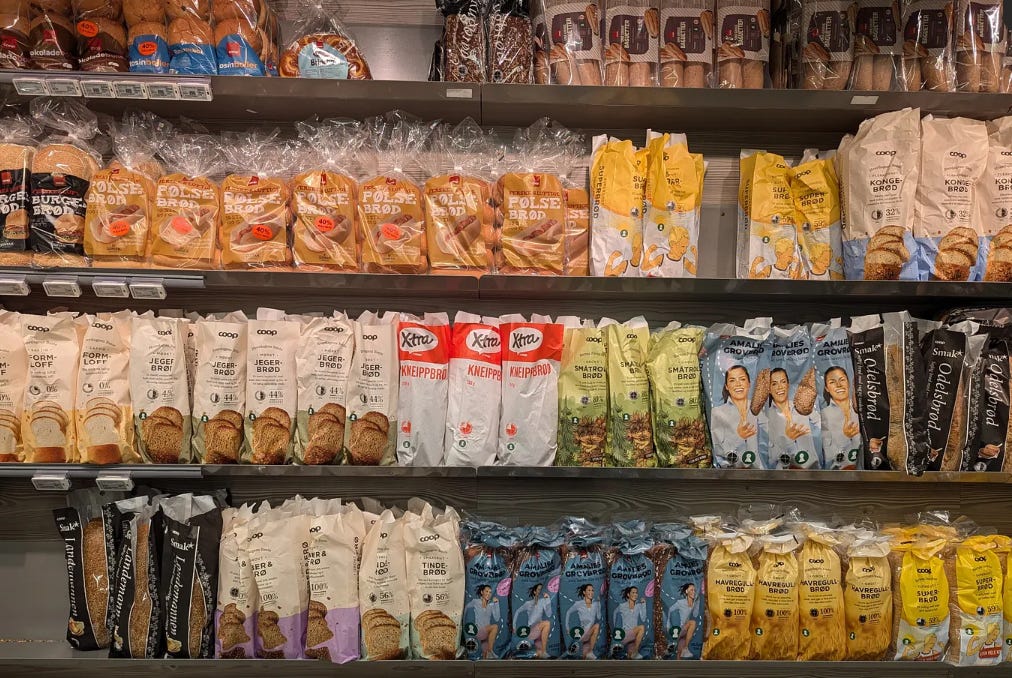
Traditional sourdough bread has an especially long fermentation process — up to 48 hours — but Americans have found a shortcut here too: add vinegar. And I guess the resulting product is sour dough — even if it’s not actual sourdough.
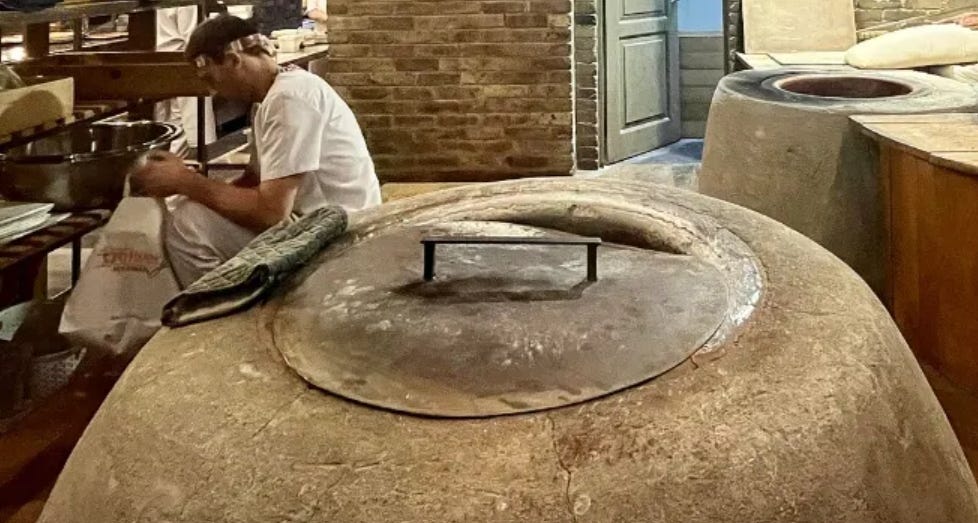
Meanwhile, while the “rising” may be at a higher temperature in America, the baking itself is usually hotter in Europe — often, in wood-fired stoves and masonry ovens. This creates better browning, crisping, and caramelization, and may also help in digestion, since the bread is less “doughy.”
That lavash bread in Armenia that was The Best Bread I’ve Ever Eaten? It’s cooked by slapping the raw dough against the wall of a beehive-shaped clay oven, and it’s so furiously hot inside that the bread can cook in thirty seconds.
There were vast mounds of lavash loaves in grocery stores and even roadside convenience stores. And these markets, however modest, often had their own fiery lavash oven right out in the parking lot.
Look, I’m not trying to start a fight.
Except maybe I am, because I honestly don’t see how there can be any real debate about where bread is better.
It’s Europe, and it’s not even close.
Americans put a very high value on price and convenience (and making as much money as humanly possible) — and don’t care enough about the bad health effects of their food to vote for politicians who will do anything to solve the problem.
Meanwhile, Europeans put more value on flavor and nutrition.
But to be fair, that doesn’t mean that all bread in Europe is amazing. Last year, Michael and I went to an Oktoberfest in Hamburg, Germany — not for the beer (since we no longer drink), but specifically for the sausages and pretzels.
The sausages were good, and my mouth was watering as I dunked my dark, oversized pretzel into a rich, spicy mustard. Then I lifted the pretzel to my mouth, eager to take that first presumably delicious bite.
And it was, without a doubt, The Worst Pretzel I’ve Ever Eaten.
Brent Hartinger is a screenwriter and author. Check out my new newsletter about my books and movies at www.BrentHartinger.com. And order my latest book below.

American wheat—unlike the ancient heritage wheat grown in Europe—also is hard on most people’s guts (and causes almost all of the so-called “gluten” allergies) because it’s a genetically modified hybrid with many more chromosomes than the heritage wheat—and our digestive tracts have not had thousands of years (much less hundreds of years) to adapt to its unrecognized genetic profile. Add to that the rampant spraying of non-organic American wheat and corn crops with (as you pointed out) glyphosate (Roundup)—and you have a carcinogenic, inflammation-fueling combination.
I purchase wheat and rye berries, grind them into whole grain flour, and immediately turn this flour into dough. I made a sourdough starter in 2015. It takes longer than yeast, so I give my dough one or two days in the fridge before baking it. I use the pre-heated cast iron Dutch oven method and turn my oven up to 500 degrees.
The resulting bread is still not as good as it is in Europe, but my European husband is grateful for it.