
Gelato is Better Than Ice Cream. But Some Gelato Are Still Better Than Others!
Lessons learned from living in Italy on how to find the truly good stuff.

Italy is one of those countries where it’s fairly difficult to get a bad meal.
As the birthplace of the frozen dessert known as gelato, it’s also hard to get outright terrible gelato.
But that doesn’t mean all gelato are created equal — not by a long shot.

First, a hill I will die on: Gelato is better than ice cream.
What’s the difference between them anyway?
Ice cream is made with sugar, cream, and egg yolks, but gelato is generally made with a lot less sugar, whole milk (or milk and cream together), and no egg yolks. Gelato is also churned much more slowly, so less air is whipped into it, and it is chilled but not frozen solid.
The end result is smoother and denser than ice cream, more intense, and served at a warmer temperature so the tongue registers more of the flavor. A little gelato goes a long way.
Meanwhile, ice cream is colder with a lot more fat, sugar, and whipped air. The fat and cold tend to overwhelm the taste buds, but along with all that air, they also make it easier to eat in large quantities.
Or, to reuse what the TV show The Good Place said about frozen yogurt: “There’s something so human about taking something great and ruining it a little so you can have more of it.”
Why exactly is Italian gelato so good?
One night in Italy, after trying a particularly good gelato, I said to an Italian friend, “I’ve had lots of gelato in lots of different countries. Ice cream too. But it never tastes this good. What’s the secret?”
She nodded sagely, as if my opinion of Italian gelato was simply objective fact.
Then she said, “You must start with fresh, local ingredients. And you must never skimp on the flavors. There are so many more peaches in peach gelato than you might think. But that’s as it should be. The point is to make peaches that taste like gelato, not gelato that tastes like peaches.”
Don’t you just love the way Italians talk about food?
After spending serious time in Italy, I’ve now become a full-fledged gelato snob. And from my Italian friends, I’ve also learned a few things about picking the best gelato.
Here’s their — and my — advice:
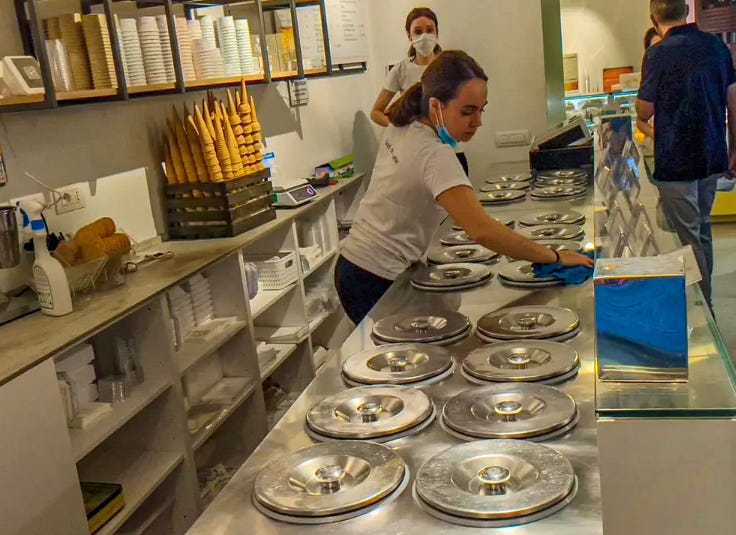
Look for sealed containers or gelato that don’t rise above the rim of a flat tray.
The best gelato is usually sold out in covered containers, which keeps the product at the perfect temperature — important for flavor. It can also be sold from shallow, lidless metal tubs that are stored in refrigerated glass cases.
What you don’t want — but what you often see in Italy’s heavy tourist areas — is gelaterias where the gelato are heaped up over the lip of the bin in huge mounds.
This is a sign that the gelato includes additives like vegetable oils or emulsifiers, or it has been frozen — both indications of lower quality.
Likewise, the best gelato is not necessarily the prettiest.
The best gelato are not brightly or vividly colored. In fact, super-bright colors can indicate the presence of food color or dyes that could be disguising the lack of real fruit or nuts. A bright yellow banana flavor is a bad sign.
In general, gelato should look like its actual flavor. Pure pistachio gelato, for example, is brownish. Sure, some gelaterias might add a greenish tint, but a vibrant green is another bad sign. Likewise, a bright green mint.
Meanwhile, don’t get too distracted by the pretty stuff on top.
“I tend to avoid flavors that have some embellishment on top, such as Oreo cookies, the corresponding fruit, nuts, hazelnuts, mint leaves, or chocolate pieces,” one Italian friend tells me. “The ingredients should be used for making the flavor and, as such, properly blended into the mix.”

Check the temperature.
When it comes to gelato, temperature is very important. When served, it should be neither completely frozen nor already melting. It also shouldn’t be glassy.
“Finding ice crystals in your gelato is bad,” another friend tells me, “because it means it melted at some point and then was refrozen, or it was poorly made in the first place.”
In fact, if you find ice crystals in your gelato, you should refuse it, as it might very well be spoiled.
Consider how it’s scooped.
The consistency of gelato is also very important: because it should be denser than ice cream, it’s best scooped with a flat metal spade, not a traditional ice cream scoop.
Meanwhile, gelato should absolutely be served in a cone, not a cup — although I concede that’s just a personal preference and not an indication of quality.

Take special note of the fruit flavors.
Fruit and berry flavors should definitely look like they’re made from actual fruit and berries. Indeed, look for seeds, pulp, or skin, which are good things because they indicate that real food is being used in substantial quantities.
Meanwhile, the best gelaterias use quality local ingredients, which means mostly seasonal fruits and berries.
Sure, they may keep really popular flavors on hand year-round, but if they have every fruit flavor imaginable, this is a sign that you’re patronizing a place that’s using mixes or bulk deliveries — especially if the fruits come in unnatural colors.
Incidentally, fruit-flavored gelato is often made without milk (and is technically not gelato at all, but sorbetto). But some fruit flavors are made with milk, and this is also totally acceptable.
It’s good if they have unusual flavors.
Another good indicator of quality? Unique flavors.
“It tends to be an indicator of quality, as it indicates their own production and dedication to their business,” says one friend.
Once, Michael and I saw a shop selling “olive oil” flavor gelato, which we had no interest in trying. But they got points for originality!
The most expensive gelato flavor to produce is hazelnut, or nocciola. And if they offer it without added chocolate, this is a very good sign of quality, because it shows they think it can stand on its own.
This is also my personal favorite flavor — an absolute taste sensation.
Read the ingredients.
Italian gelaterias often post signs with their ingredients — and it’s a good sign when they do: a quality gelateria will be proud to show off their fresh, local, quality ingredients.
Even so, here are some ingredients to look out for: olio vegetale (or vegetable oil) or artificial colors and flavors (which are often indicated by numbers or letters).
One very popular Italian flavor is frutti di bosco, which means “fruit of the forest,” and is typically made from whatever berries or cherries are in season. If they have it, you can read the label to see if your gelatario (or gelato-maker) is using seasonal fruits.
Sample the fior di latte or fior di panna, even if you don’t ultimately choose them.
These are the most basic flavors of gelato, offered by most premium gelaterias: fior di latte means “flower of the milk,” and fior di panna means “sweet cream.” They’re generally made with the highest quality milk or cream, and the flavor can be very subtle, like a very mild vanilla.
If neither of these flavors is offered, it’s a bad sign. But it can also be a bad sign if the flavors include chocolate chips, or pieces of fruit, or are drizzled in syrup. It might mean they’re trying to disguise lower-quality cream or milk.
“I do not like this practice,” says one friend. “They are using the cream as the base and the syrup to provide the flavor.”
A respectable gelateria will allow you to sample their wares, and the fior di latte or fior di panna are good choices to try to discern overall gelato quality, even if neither is the flavor you finally choose.
Overwhelmed? Ignore me.
Look, I’ve already admitted I’ve become a total gelato snob, and we all know that nothing sucks the joy of something faster than when someone nearby is being a snob about it.
In short, I’m giving you permission to take whatever makes sense from everything I’ve written here — and completely ignore the rest. In the end, the whole point of gelato is to enjoy it.
So enjoy it!
And if you’re ever in doubt, just get the chocolate — either cioccolato fondente (without milk) or cioccolato al latte (with milk).
I think we can all agree it’s hard to screw up too badly when you’re making something out of pure chocolate.

Brent Hartinger is a screenwriter and author. Check out my new newsletter about my books and movies at www.BrentHartinger.com. And order my latest book below.

When I saw this headline I knew there was going to be trouble! Then as I read, you got everyone of my counter points. Having been in Italy over 3 years now, you can spot the tourist spots right away with the overflowing heaps of “gelato” with all the things added in to appease ice cream lovers. Keep it simple.
I had a transcendent experience in Bologna when I first arrived in Italy at Cremeria Cavour trying the nocciola. It wasn’t just better, it was as if I’d never had “ice cream / gelato” before. During my first taste I stopped, looked at my partner, shocked.
Great! Shared